The revenue leader’s guide to surviving a recession - 3 critical steps
The talk of global inflation is everywhere. US inflation hit 8.6% in May, the largest annual increase since December 1981. Europe and the UK are in a similar situation.
Over two thirds of economists believe a recession is likely to hit in 2023 according to a Financial Times survey of 49 macroeconomic experts. Could this be a Darwinian moment where only the fittest will survive? We believe it’s time to make sure you are ‘fit’ from a sales-organisational perspective.
As revenue leaders our job is not just to hit a number; our job is also to pre-empt problems and develop the sales organisation; herein lies both the problem statement and the solution for this moment.
This newsletter is an extract from our recent white paper and has been produced to help revenue leaders prepare and sustain themselves in the event of an economic downturn. Two important questions to ask:
Can you continue to think and act in the same and get the results you need?
Is this the early warning needed to finally get the sales team sorted out?
There are three themes you need to focus on to weather the impending storm:
Protect – your strategically key relationships
Differentiate – you and your value proposition
Systematise – your sales approach
Protect
You and your business undoubtedly have many important assets but…
…are any of your assets as important as the relationships you have with your customers?
We have long asserted that customer relationships should be treated as assets to your business.
1. Strategic Account Planning
You must get strategic with how you protect your key relationships (accounts) and you do so by making sure you implement a strategic account planning process.
Many account-planning processes we see are often home-baked and not fit for purpose. It is worthwhile investing in an account planning tool to help you build a robust relationship strategy. Here is our recent post on account planning if you wish to read further.
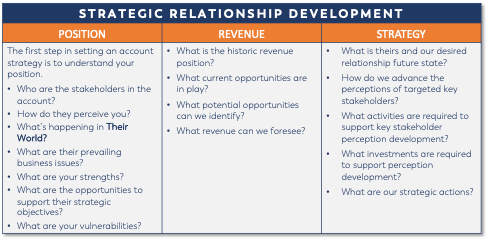
The table below illustrates the key questions your account planning process should address. Answering these questions for your key strategic relationships is an important step forward.
2. Relationships
Categorise your relationships and identify those you ‘Must Keep’. These are the relationships that need most attention and those to whom you should be devoting time and resources.
3. Customer hyper-care
Having categorised your strategically important relationships. You now need to determine how to provide them with customer hyper-care. This does not mean shower them with gifts and corporate hospitality (although there could be some elements of this).
We are talking about a level of ‘hyper-care’ that will proactively manage the effectiveness of your service and product delivery and quickly address any actual or potential drop off in perceived quality.
4. Be more strategic
Do the research and get deep into your customer’s world to specifically identify the issues they think are important in the near to mid-term.
Figure out how you can help them address these issues. Remember buying decisions are based on solving business issues. Identify the issues you can help them solve, understand how those issues are affecting them, who owns the issue and how much of a priority they perceive it to be.
5. Grow
The only way to protect a relationship is to grow it. This does not mean indiscriminately trying to sell more products to your client; that usually ends up having a detrimental impact.
Innovative thinking is needed, which does not mean invest in new products and services; it’s about finding problems and opportunities the customer has not seen or is not aware of and helping them source the solution.
6. Account Based Marketing (ABM)
It’s time to get your account team together to refresh the strategy and align with marketing. ABM starts with research into your customer’s world. What are the trends and events that are affecting their business at the macro, industry, and their business level?
Then identify who are the stakeholders in the account who own these issues. What insights and perspectives can you provide on how these issues could impact them and what ways they can employ to solve them.
Differentiate
1. Customer Centric Engagement
Buyer research has been very consistent in telling us what buyers want when they meet with salespeople. Your people should follow these four simple ‘principles’ for creating value when meeting customers:
Know them - research their business and demonstrate that knowledge to a high level.
Make good use of their time - facilitate mutual and compelling discussions that respect their time and abilities.
Solve their business issues - demonstrate commitment to what happens after the sale.
Educate them - differentiate by sharing insights that help them make decisions, develop their understanding, and expand their expertise.
2. Articulate your value clearly
What we see as 'our' value, is not necessarily what the customer sees it to be. Customers often need salespeople to join the dots for them.
You cannot articulate your value proposition (your capabilities) until you fully understand their objective and to understand that you need the following information:
The issue they are trying to solve and its causes
How it is impacting them and their business
The value of solving the issue and the specific outcomes the are looking for
Their sense of urgency to act
Their vision of what the solution should look like
Only when you know this information can you connect your strengths, capabilities and experience to creating the outcomes they need in a way that is meaningful to them.
3. Insights and perspective
Customers want to be educated on new, better ways to address their challenges. They do not have all the answers and in fact your perceived value will rise exponentially when you focus on delivering value over and above products and services.
You have a rich capacity to provide insights and perspectives from your experience with other customers, your understanding of your customer and your knowledge of your own solution capabilities - as the diagram below illustrates.
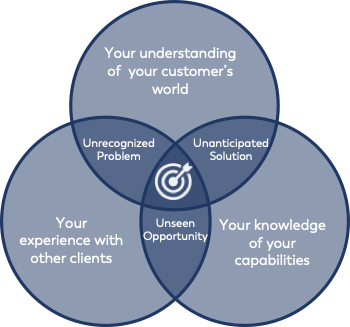
"The ability to give insights and perspective sits at the intersections"
4. Make the way you sell the differentiator
Differentiation at the product or service level is short lived unless you have IP or patent protection. Many salespeople bemoan the commoditisation of their marketplace and yet, true differentiation happens through the way you engage with the customer.
The chemistry you create through your intent and purpose to develop the relationship can be natural for some, but most need training and coaching on skills, tools and methodology. Don't kid yourself – this matters. It matters to your customers, but it also matters to your sales teams as well.
They need to feel like they are equipped to do the job. Salespeople who feel like they have the right level of enablement are likely to stay with you. Imagine losing your key salespeople during a recession!
Systematise
You may know that we advocate the systematisation of sales and the boost this provides to sales results. We know it sounds like a good idea but why?
1. Conscious Competency
The Pareto rule tells us that 80% of our results come from 20% of our assets - sales is the same. This is not healthy because the 20% producing 80% of your results, place your business at risk. You should ask these questions:
What happens if the 20% leave?
Can you get more from the 20% if they see themselves to be out-performing?
It’s the middle-performing 60% who’s performance needs shifting.
The competency model normally states the highest state of competency is Unconscious Competence. In some fields of endeavour this is true. For sales we disagree.
Research tells us that in sales (as in most professional crafts), we are not good at identifying and describing the behaviours that make us successful – they must be observed.
Successful salespeople are mostly Unconsciously Competent, which is not desirable because when this happens:
Successful salespeople often mischaracterise why they are successful
They may appear to be endowed with mystical (sales) powers
To other salespeople their performance can look out of reach
It appears that what makes them successful cannot be replicated, taught and scaled
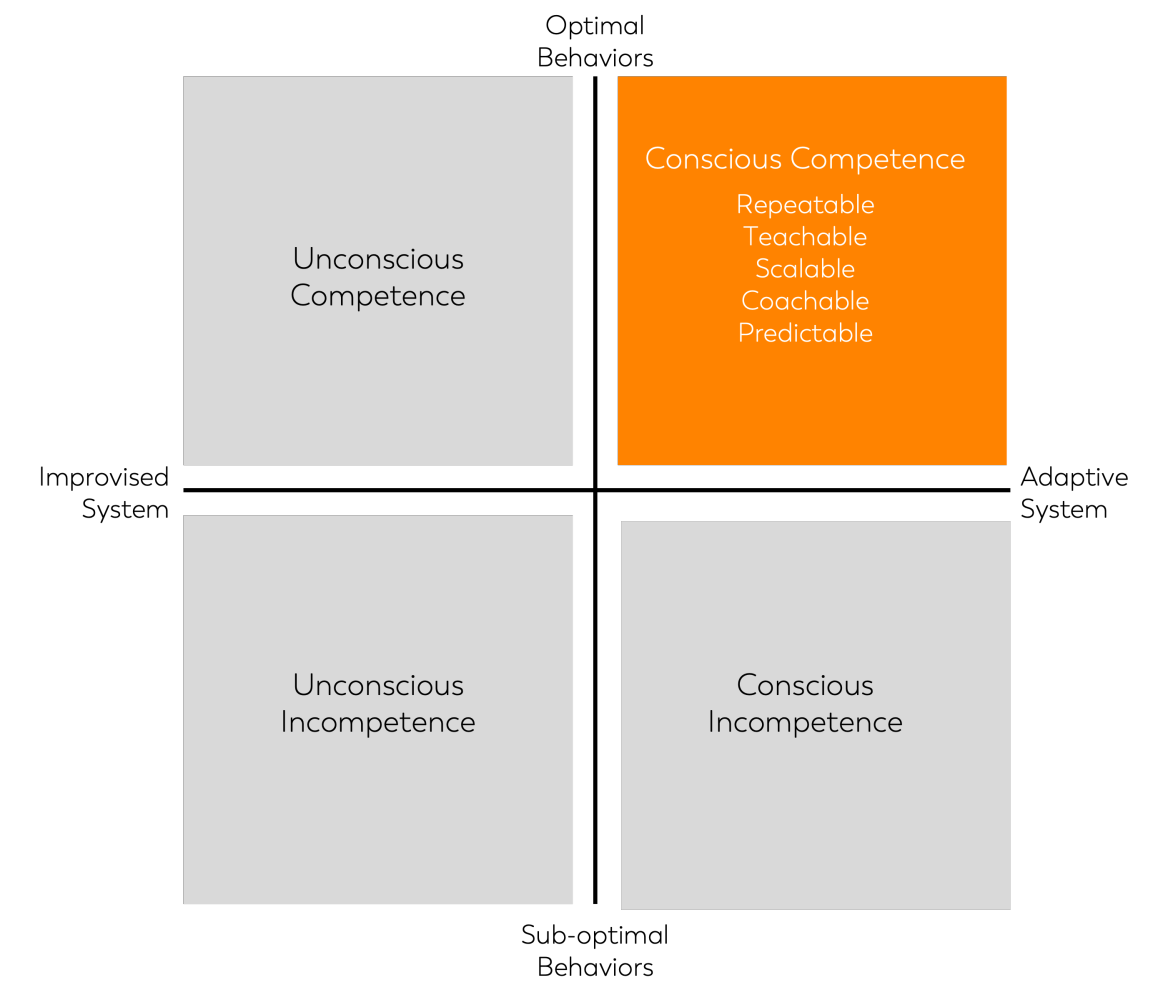
We believe the desired state for successful salespeople is Consciously Competent, because when this happens, we know why they win and why they lose. This becomes replicable, teachable, scalable and predictable.
A salesperson can be in any of these quadrants at any point in time. The purpose of systematising sales is to get as many of your salespeople operating in the Conscious Competence quadrant more of the time.
2. Process, tools and methodology
How do you get salespeople into the Conscious Competency quadrant? Through training and sustaining process, tools and methodology within your organisation.
The purpose of systematising sales is to get your salespeople to practice the behaviours that create sales success - more of the time. We call these success behaviours.
Process – think of process as a bridge for behavioural development. What seems like a process at first, when repeated often enough moves from process to habit, behaviour and ultimately to culture.
Tools – the instruments of the trade; meeting, opportunity, account planning tools (there are more). Without these, salespeople lack process and structure. Behaviour and language develop around tool usage, fostering consistency of thinking, approach and execution.
Methodology – is the ‘how’ of sales and often incorporates both skills, tools and process. Businesses that adopt a common methodology report significant outperformance across their sales metrics inclusive of sales employee retention.
3. Training and Coaching
Sports teams compete; sales teams compete. Sports teams train and are coached regularly; sales teams mostly are not.
Training is an initial knowledge burst needed to introduce a new capability or tool. Coaching helps build the muscle strength across the needed capabilities.
Developing a coaching culture requires leaders to have the skills to coach but also to ensure they set enough time aside for coaching activities. They need to know when to coach, what to coach and how to coach.
Final thoughts...
There’s still time to get yourself ‘recession ready’!

Maybe it will be bad, maybe not, but what’s the worst thing that can happen when you ready yourself and systematise sales? Your sales organisation:
Is better organised
Is optimised for success,
Can compete more aggressively
Generates more revenue
Is more predictable
…and as leaders we will have done everything we can to protect our people and our business against what is to come.
Don’t wait and hope for the best, get busy now. Procrastinating won't make what comes next easier, ask yourself this:
How much has doing nothing cost you already? AND how much will it cost you in the future? Do the math and embrace the opportunity to get more from your sales organisation.
This is what we do at Transform2perform, we help you transform sales and business performance. Download our eBook to get deeper into each of the four 'Cs’ and or connect or call us for a chat on how we can help you.