
Make Strategic Account Planning Your Competitive Advantage
When 50% of your revenue comes from just 5% of customer relationships; losing a key strategic relationship can have far reaching implications - the loss of existing revenue, future revenue, market share, key people, and the increased likelihood of competitor encroachment.
These strategically important relationships should be treated as business assets. It is imperative you PROTECT and GROW them, because it costs six times as much to re-acquire an unhappy customer than it does to keep a satisfied one.
In this three-part newsletter we will be covering how to make Strategic Account Planing a competitive advantage.
Part 1: From Business Rationale to Account Selection
Part 2: Implementing a Strategic Account Planning Process
Part 3: Executing Successful Account Planning Meetings
Introduction
Strategic Account Planning is critical to developing profitable client relationships. Yet for so many businesses it is an underdeveloped process, that often fails to achieve its objectives. In so many cases, even the ownership of this strategically important process remains unclear.
We cannot emphasise enough how important Strategic Account Planning is to your business because many of the challenges you face when selling B-B are solved by this critical business process.
Solving Sales Challenges
Research from Korn Ferry in ‘The 2021 Buyer Preferences Study’ advises that Buyers consistently reach out to Sellers later in their buying process. According Korn Ferry, over 79% of Buyers wait until they have fully defined their needs and, 57% identify solutions first, before reaching out to Sellers.
Compounding this further; 68% of Buyers say that when they engage with Sellers their experience either falls below or (just) meets expectations. On only 32% of occasions do Sellers exceed expectations.
On the surface this may not sound so bad, however just meeting expectations has become ‘a sea of sameness’. As a result, Buyers have developed a generalised perception that Sellers create mostly undifferentiated experiences - offering low-value in the early stages of their buying process.
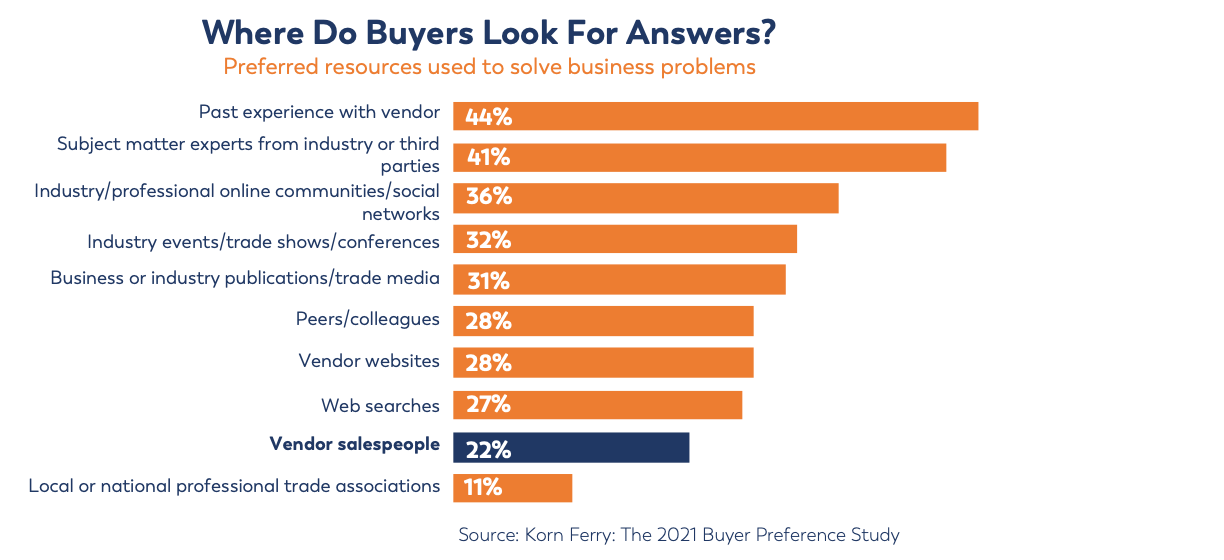
This is further underscored when we consider Buyers rank Sellers a lowly 9th place in a list of 10 resources they turn to when they need to solve a problem according to the same Korn Ferry research.
Your Sales System
To understand why Strategic Account Planning (SAP) is so important to your business, we first need to discuss its place in your sales system. All sales organisations operate a sales system, the only difference is how systematised you are in your approach.
The Sales System is a series of interconnected client management activities that position the customer at the centre. Every business that sells will in some way practice these four customer management activities:
Relationship Management
Opportunity Management
Demand Generation
Client engagement
Strategic Account Planning is the process you employ for Relationship Management. Its purpose is to protect and grow your strategically important relationships. The system is symbiotic for instance; you will not have many relationships to manage if you don't manage (and win) opportunities and, vice versa.
Understanding how Strategic Account Planning as a business process connects to other elements of the sales system is key to seeing its commercial value.
Three Key Objectives
A well implemented and executed Strategic Account Planning process must help you overcome the challenges frequently faced at the opportunity pursuit level.
Your Strategic Account Planning process should achieve the following three key objectives:
Create meaningful recognised differentiation over the longer term
Identify opportunities earlier
Get out in-front of the buying process
Commercial Advantages
Business leaders should be in no doubt about the commercial advantages a well implemented and executed Strategic Account Planning process offers. Advancing the relationship status changes the way account stakeholders perceive you. When the relationship status is elevated, the way you are treated changes. It is less transactional, and it becomes increasingly more partner orientated. There are real and material commercial advantages that impact key business results:
You are differentiated in their eyes
The Influence of competition is diminished increasing the probability of sales success
The importance of solution features diminishes
Price sensitivity diminishes protecting margins
Relationships are broader and deeper
You develop stronger advocacy
You hear about opportunities earlier
You have access to key decision-makers
Business results change
Revenue per account increases
Cost of pursuing opportunities decreases
Businesses grow together
Selecting Strategic Accounts
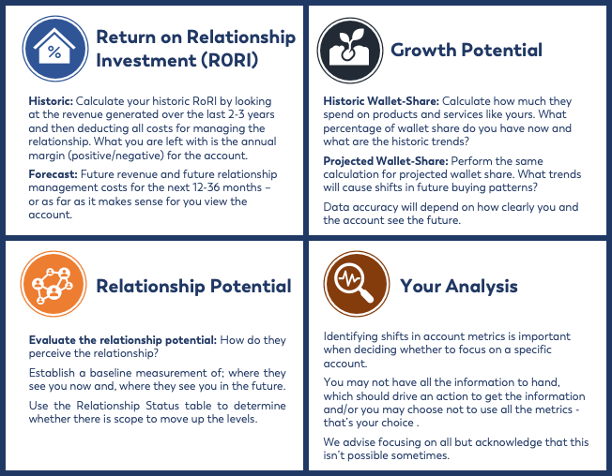
A huge part of successful Strategic Account Planning is acknowledging there are limited resources and then trying to optimise the allocation of those resources. Here is a simple 4-step framework to help you calculate RoRI to guide your strategic account selection:
Final thoughts
Remember the primary purpose of Strategic Account Planning is to advance your customer’s perception of you and your business – this is the game we play! Any business that places value on continued and repeat sales needs to have a robust and effective Strategic Account Planning process.
The first step is account selection. This is an integral part of the overall business strategy because resources are limited, and businesses need to invest in relationships that will achieve the highest RoRI.
In Part 2, we talk about how to implement a Strategic Account Planning process, the framework to implement, the account team, and the cadence around successful execution.
This is what we do at Transform2perform, we help you transform sales and business performance. Connect or call us for a chat on how we can help you.
