
DO YOU TREAT YOUR STRATEGIC CUSTOMER RELATIONSHIPS AS ASSETS?
Losing a strategically important customer can be catastrophic on so many levels. The value of your strategic relationships cannot be understated. These relationships should be seen as assets to your business, here’s how to PROTECT and GROW your assets.
We continue on from the last newsletter focussing on how we systematise sales through the four C’s (Capabilities, Culture, Compensation and Company Structure). We started with capabilities and each newsletter profiles one capability that all sales organisations should master and how to do it.
This edition focuses on Strategic Relationship Development or as its also known - Account Planning (we use these terms interchangeably).
Your Key Strategic Relationships
It’s a commonly accepted benchmark that 50% of revenue comes from just 5% of customer relationships. Your relationship with that 5% - your key strategic customers is a critical asset to your business. We want to encourage you to see that relationship as an asset and treat it as such.
Losing a strategic customer relationship can have far reaching implications for your business, namely the loss of:
Existing revenue
Future revenue opportunities
Market share
Key people
And the increased likelihood of competitor encroachment
It costs six times as much to reacquire an unhappy customer as it does to keep a satisfied one. Yet, we seldom come across an organisation that does account planning well (if at all). It is a business imperative to PROTECT and GROW these critical assets because your existing strategic relationships provide current and future revenue opportunities.
Strategic Relationship Development – What it shouldn’t be
Working with our customers we see a variety of approaches to account planning ranging from the rudimentary to the more complex. Rarely do we observe an account planning process that achieves what it needs to. To be blunt, most are home-baked, ineffective, superficial, and not up to the task of PROTECTING and GROWING your key assets. Here are some common features of poor account planning processes:
Just adding a number to last year’s revenue; ‘let's increase by 20%...’
It is superficial, completed once and then shoved in a draw and never seen again
It does not involve the customer in the planning process
Focus is exclusively on what the seller wants
It is light on research, lacking deep understanding of the customer’s business, their challenges, drivers, market, differentiators, competitors’ and so on
There is little or no executed strategy
No strategic targeted perception development
It does not focus on creating long-term differentiation
This list is not exhaustive, and we could go on but we should focus on what your Account Planning process must be.
Strategic Relationship Development – What it must be
Protecting and growing your strategic (relationships) assets is a business imperative. In fact, research tells us that just protecting relationships is ineffective. The only way to protect them, is to grow them and that means continually advancing the relationship.
You must manage your strategic relationships for mutual advantage; not just for you and not just for the customer either. Long-term successful relationships are win-win, anything else will fail at some point. There is however an uncomfortable truth for all sales and account teams to accept:
You are responsible for your customer’s success as well as your success
You are responsible for your customer’s perception of you in every aspect of the relationship
You must make consistent measurable contributions to their profitability and their customer relationships
The name of the game is perception development. Advancing the perceptions of key stakeholders in the account is ‘the work’ and, is ‘growing the relationship’.
Quantifying their perception of you requires your constant attention as this can change very quickly. There are a range of factors that can influence their perception of you:
Your efforts and influence
Their internal influences
The competition
Innovation and market shifts
All of which factor into the way they perceive you.
As you move through the scale shown in the table above, toward the rarefied air of ‘Trusted Partner’ status, the benefits often far outweigh the investment required to get there because you are perceived differently to others.
You are differentiated – the relationship is about more than your products and services
Price becomes less of an issue - your value is greater than just your products and services
You are seen as a problem solver and they reach out to you earlier in the buying process
The influence of competition diminishes and you are harder to dislodge
But first you have to identify where each key stakeholder is on the scale and work forward from there.
Systematising Strategic Relationship Development
First point to note - Strategic Relationship Development is a business process. It requires rigour, a framework and a cadence of consistent review and revision.
We see the best Account Planning results when a methodological approach is adopted that propagates a common language, strategic principles and process steps that are followed across the whole organisation.
Shying away from implementing this critical business process is done so at your peril.
The table below indicates some of the key strategic considerations to continuously review and consider when putting your Strategic Relationship Plan together.
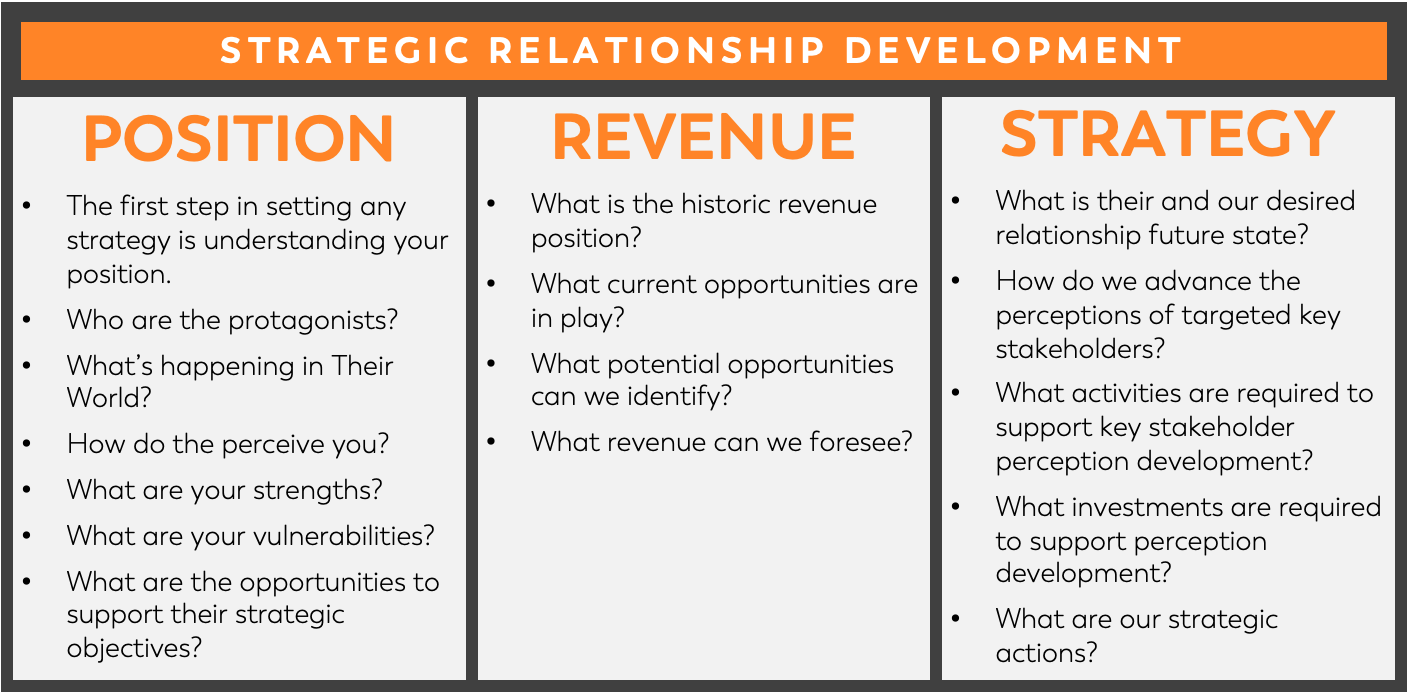
Where we see so many account strategies fail is the front-end work – the research required to understand your position. Your strategy is only as good as the information you input into it. Many account plans fail because the information is often surface-deep, unqualified, subjective wishful thinking or not up-to-date and reflective of the current reality.
A business strategy has a slim chance of success if the information it depends on is inadequate or inaccurate.
Internally you need to decide who sits on the account planning team for each strategic customer - you may have done this already. Account teams should be cross-functional, with representation from all customer touch points.
Account ownership should be clear, and account owners must be accountable for the relationship in its entirety. Remember there are three main objectives of the Strategic Relationship Development process:
To advance the perception of YOU with key stakeholders in the account
To identify new opportunities earlier
To get in front of the buying process
Choosing Your Approach
There are plenty of account planning tools and methodologies out there for you to use to advance your strategic relationships. Of course we recommend choosing one that makes sense for you, however the methodology is nowhere near as important as the effort required to adopt and sustain a robust and dynamic Strategic Relationship Development process.
Last piece of advice. Strategic Relationship Development takes time and requires work to deploy and implement. You may not see the immediate benefits because remember this is the strategic long-game.
You need both strategy and tactics in sales so don't get disheartened if the dial doesn’t move immediately. However you must persist with it and keep to the process diligently because the effects will show up, and when they do you will very grateful you invested in a Strategic Relationship Development process.
This is what we do at Transform2perform, we help you transform sales and business performance. Download our eBook to get deeper into each of the four 'Cs’ and or connect or call us for a chat on how we can help you.